Three tips for designing digital tools for micro-entrepreneurs in the informal economy
Mastercard Strive ―
The following guest article by Shujaaz Inc, a network of social ventures based in Nairobi, offers practical insights on designing digital tools for micro-entrepreneurs.

Photo credit: Courtesy of Shujaaz Inc
The following guest article by Shujaaz Inc, a network of social ventures based in Nairobi, offers practical insights on designing digital tools for micro-entrepreneurs, particularly those in informal economies.
Digital transformation in Africa has created big opportunities for micro-entrepreneurs to flourish. The rapid adoption of mobile across the continent has offered unprecedented opportunities for growth, through new skills training opportunities and fintech innovations.
Our research shows that, in Kenya, 31% of 15- to 24-year-olds are now informal sector entrepreneurs. This group earns twice the average income, often creating work opportunities for young people in their communities, and in 2019 added $290 million a month to the economy.
With the support of Strive Community, Shujaaz Inc set out to understand the experiences and challenges faced by informal sector micro- and small enterprises (MSEs) in Kenya. Last year, our team ran a range of innovative mixed-method focus group discussions and SMS surveys with young entrepreneurs across the country. These conversations focused on: existing barriers to digital adoption, the digital channels MSEs are currently using, and what tools and support they need at the different stages of their entrepreneurial journey.
The research provided a range of important insights that have informed Strive Community’s ongoing partnership with our sister company MESH, as the MESH team works to scale the first online community for entrepreneurs in the informal sector. In particular, this research has influenced the design of MESH’s skills training content.
Following our first post, which highlighted our “GroundTruth” research methodology, in this second post for the Strive Community, we share three key learnings from our research that helped advance our thinking. These lessons can serve as guidance to anyone looking to build digital tools for micro-entrepreneurs, particularly those in informal economies.
Having a smartphone doesn’t equal digital adoption.
A mistake that many of us make when designing new tools is linking digital engagement and the adoption of digital tools to the ownership of a smartphone. While such a link seems natural, the reality is more complex.
In our recent study, 64% of micro-entrepreneurs reported owning a smartphone. In theory, that would mean that 64% of those entrepreneurs would be using the internet and that most of them would likely take advantage of it for the purposes of their business. However, in reality, only 39% said they use digital tools, such as social media, e-commerce or other software, for their businesses.
Why? Some young entrepreneurs who are just starting out might own a smartphone and pay for a bundle that includes WhatsApp and Facebook. But they might not have enough data to download or use other business or fintech websites or apps. Our research found that more established micro-retailers, who still operate mostly in-person shops, are more resistant to using services like digital skills training because they can’t see its value in their “face-to-face” world.
At Shujaaz Inc, we call this the “rejection scale.” It’s one of the ways we segment and design for our audience. In this instance, we found three groups:
- Active rejectors or hesitators: This group doesn’t see why they should connect to the internet and are not willing to try since their customers are close to them (in this case, the more established retail entrepreneurs running fixed stalls).
- Open-minded: These entrepreneurs are already on social media for other things but are open to trying digital business tools with some training.
- On-side and already learning: They are connected to the internet and explore various applications. However, they need support to hone their skills and confidence using digital tools.
This audience segmentation allowed us to design more effective marketing and onboarding user journeys that are tailored to address the barriers young entrepreneurs are facing.
For example, for MSE owners resistant to digital and the internet, we have harnessed our multimedia platform Shujaaz to share success stories of young entrepreneurs who have benefited from digital skills and training. These positive peer influencer models help young people who might have rejected digital to see that (as Seth Godin would put it) “people like us do things like this”; it’s a powerful way to build confidence in testing or adopting new digital tools.
For the open-minded group, we focus on platforms they already use and trust — to “ease” them into the world of new, digitally enabled opportunities. For example, we actively use Facebook and WhatsApp to engage with this group and demonstrate new tools and services. Meeting people where they are — in the digital space — can help with the digital transition from the basic to a more advanced user level.
For young people who are already online, we capitalize on platforms our study showed they already use and trust, like Facebook or WhatsApp. Meeting people on such platforms can help with the transition to additional advanced tools.
The takeaway: If you’re designing products for entrepreneurs in the informal economy or in countries where the digital transition has only just begun, remember that digital adoption isn’t an on/off switch! Design your marketing and onboarding to catch those users who still need support to see the value digital tools can play in their lives.
2. Micro-segmentation matters for skills training.
We’ve found that when products and services are designed for the informal economy, they’re often targeted to one group: young informal sector entrepreneurs. But each stage of the entrepreneurship cycle requires different training and different types of support.
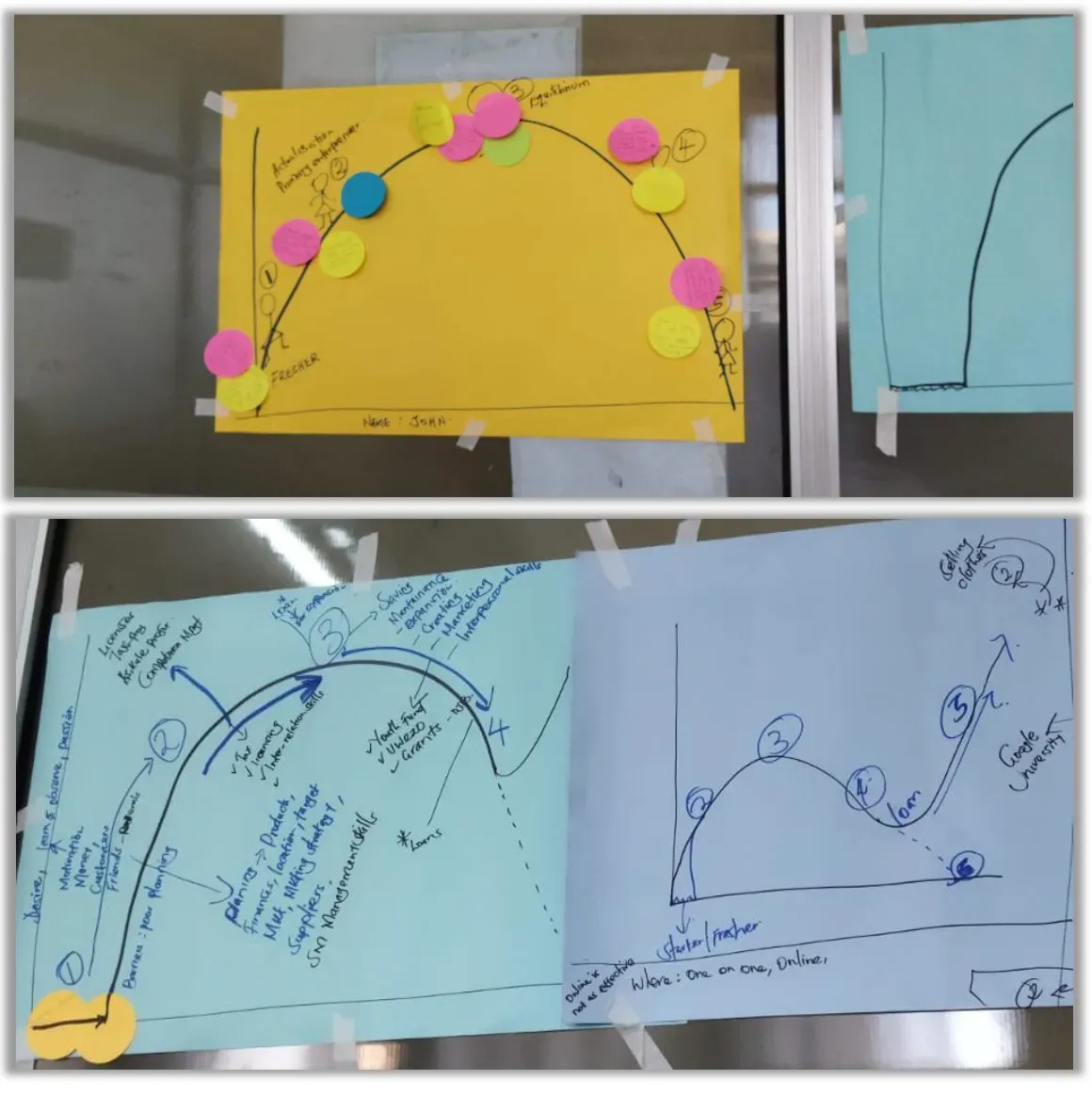
Each stage of the entrepreneurship cycle requires different training and different types of support. Photo credit: Courtesy of Shujaaz Inc
As we dug into the detail of those stages, a few key insights were revealed as we designed skills training content:
- Time is money. Training must be valuable to justify time away from business activities, particularly for those who run retail stalls. For the young people we spoke to, anytime away from the shop is considered money lost. This means that any skills content must demonstrate its value up-front to get engagement and trust.
- With-consent data is your ally. The first training course an entrepreneur engages with matters. When the course matches who they are and what they care about, it leads to higher completion and retention rate. Harnessing consent data — data which is obtained through clear permission by the user — to match users with the right content is a powerful strategy.
The takeaway: While digital transformation and the spread of mobile phones are revolutionizing business in Africa, we need to be aware of the nuances that affect adoption and use by the micro-entrepreneurs who need them. Localization and segmentation are the necessary ingredients to skyrocket adoption and improve the lives of young entrepreneurs in Africa.
3. For young entrepreneurs, community matters.
Entrepreneurship can feel lonely. Our research showed that young Kenyans in business feel that they don’t get enough support from family and friends, and they crave someone to guide them in their journey of building a business.
This is particularly relevant when it comes to designing digital skills training. In our discussion groups, several MSEs said they were looking for mentorship, networks, and community, and that they’d prefer to learn or do skills training with other people. Experienced entrepreneurs say that the best lessons and secrets are shared directly by other experienced business owners.
This founding insight behind MESH’s innovative online community continues to shape their work with Strive Community to harness the power of online peer-to-peer training and peer engagement to supercharge skills training content. As part of the MESH community, members can access an extensive library of peer training videos and connect with peers and mentors with complementary skills or interests.
The takeaway: The critical role of peer-led and community-centric design is important for anyone building and launching digital tools for entrepreneurs in the informal economy. For this group, as for all of us, if we’re trailing something new, knowing that peers in our networks are also trying it reduces the barrier to entry. If we can pair powerful digital tools like micro-loans or job matching with existing and new networks and communities, we’ll more effectively meet young entrepreneurs where they already want to be: with entrepreneurs like them.
Through the support of generous partners like the Strive Community, MESH, the first online community for entrepreneurs in the informal economy, will continue to enable young entrepreneurs to make meaningful connections with peers they can trust. MESH, a part of the Shujaaz Inc network of ventures, allows young entrepreneurs to connect and grow their networks, boost their skills and earnings through unique peer-to-peer training content, and access opportunities tailored to them.