New insights, real impacts: Introducing the 2024 update of the Mastercard Strive Small Business Evidence Map
Mastercard Strive ―
By Hana Hanfi, Marius Karabaczek, and Elise Montano from the Measurement & Impact team at Caribou Digital.
By Hana Hanfi, Marius Karabaczek, and Elise Montano from the Measurement & Impact team at Caribou Digital.

- The Small Business Evidence Map has been updated with new impact evidence on digital and data-first interventions for small businesses.
- New studies added to the Evidence Map are increasingly focused on digital upskilling and breaking down barriers for women-led businesses.
- Emerging evidence on the impacts of artificial intelligence and data innovation on small businesses is mixed.
- Mastercard Strive continues to integrate evidence-based decision-making in its programming for small businesses, particularly as we increase access to finance, leverage AI-driven solutions, and design programs tailored to women entrepreneurs.
To support small businesses around the globe, Mastercard Strive relies on evidence-based decision-making to design more effective and impactful programs. But sifting through the noise to find relevant, meaningful impact evidence requires a significant amount of work. To address this, Mastercard Strive launched the Small Business Evidence Map last year. Today, we’re pleased to announce the Evidence Map has been updated with new studies and an improved user interface.
In this article, we share some of our learnings and insights from these new studies.
1. New studies have an increased focus on digital upskilling, particularly on training via apps.
Forty percent of the new studies focus on digital upskilling initiatives, 17% on digital financial services, 10% on market participation strategies, 10% on business operations, and 23% on combinations of support forms.
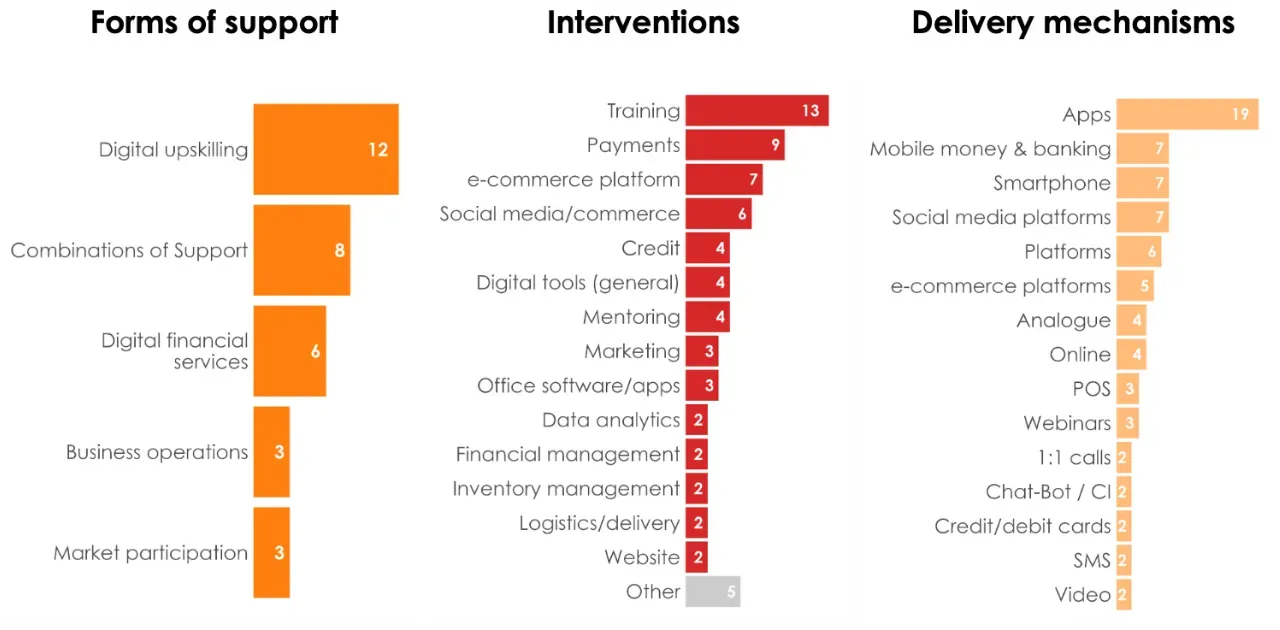
Most studies still show positive impacts (75% of data points). However, there was an increased willingness to report null results — 23% of data points, up significantly from 11% in the first edition of the Evidence Map. Digital upskilling, the most frequently studied intervention, also has the highest number of positive impact points, particularly in categories such as the adoption of business best practices and digital solutions.
2. New studies reinforce that access to digital financial services offers small businesses opportunities to improve their business practices, resilience, and growth.
Building on findings from 2023, new evidence reinforces the impact of digital financial services across multiple small business outcomes.
- Multi-country research by Alina Malkova found that access to mobile money increased the likelihood of entrepreneurs formalizing their businesses by 3.1 percentage points.
- In Mexico, a government initiative to distribute debit cards to low-income households resulted in a shift in digital payment adoption among corner stores, with 18% implementing digital point-of-sale systems. This led to a network effect that encouraged broader adoption of digital financial tools and increased the probability of formalization by 19%.
- In India, the fintech Fundfina provided small business loans for those previously excluded by traditional financial institutions, which resulted in 80% of its small business customers reporting improved financial management. Ninety percent said they had higher revenues after receiving a loan, with just over one in five reporting sizable gains.
These findings demonstrate how access to digital finance can drive business growth and contribute to the overall resilience and success of small businesses.
3. Emerging evidence highlights the mixed impacts of AI and data-driven innovation on entrepreneurs.
The first randomized controlled trial (RCT) on the impact of generative AI on small businesses in developing economies took place in Kenya and was published in 2024. It tested a WhatsApp-based AI assistant, built on ChatGPT 4, with 640 entrepreneurs. Results varied based on pre-intervention performance: high performers saw a 15% increase in business performance, while low performers experienced an 8% drop. The study revealed that entrepreneurs who saw the most benefits tended to ask specific questions and critically evaluate the AI’s advice. Those with fewer gains asked more generic questions and were less discerning. These findings suggest that programs introducing AI tools for small businesses should account for varying levels of digital literacy and critical thinking among participants.
Beyond generative AI, data-driven innovations are enabling entrepreneurs to make more informed strategic decisions. In Rwanda, an RCT tested a mobile app that provided small retailers with analyses and visualizations of sales and marketing data. Firms in the treatment group increased monthly sales by 36% and profits by 29%, and reported increased use of data-driven decision-making. The app also significantly improved their personal analytical ability, enhancing business performance and entrepreneurial skills.
4. New evidence on what works in breaking down barriers for women-led businesses.
Limited market access can be a challenge for women entrepreneurs, particularly in emerging economies where women may face constraints to participating equally in the labor force. Layane Alhorr’s RCT with Jordanian women entrepreneurs tested the impact of Facebook business page support and digital marketing training. Women entrepreneurs in the treatment group doubled their use of Facebook business pages for marketing. They saw increases in client numbers, weekly revenue, and overall business performance. Effects were strongest for women with less ability to leave their homes, showing how digital tools can expand market access for entrepreneurs facing social mobility restrictions.
In Mozambique, a bundle offering mobile money access and financial management training resulted in a significant increase in profits for women, but not men, narrowing the gender gap in profit. These findings highlight an important complementarity: providing micro-enterprises led by women with both enabling technology to build savings and financial management skills focused on applying these savings effectively can maximize business returns.
Another challenge women entrepreneurs may face is pressure to divert their business income to household members. An RCT in Uganda found that female micro-entrepreneurs receiving loans via direct mobile deposits saw a 15% increase in profits and an 11% increase in business capital compared to those given cash disbursements. This group also increased savings, as digital management allowed discreet financial control, reducing pressure to share income with family.
Mastercard Strive continues to integrate this learning within its programming. Our programs enable access to credit, and partnerships with MayaSoft, Boost Capital, Open Contracting Partnership, and others will enable over 15,000 small businesses to qualify for credit and see over $5 million disbursed as loans to small businesses. With AI-driven solutions, the Mastercard Strive EU Innovation Fund recently announced winners — including Direct Market, It Goes Forward, IVÆKST, and Ragna — developing AI-driven solutions that drive greater efficiencies for small businesses. Mastercard Strive is funding three innovative partners — Impaqto, INCAE, and nilus — who are tailoring digital solutions to women entrepreneurs in Latin America to address the barriers they face.
We encourage organizations supporting small businesses to explore the updated Small Business Evidence Map to help guide their programmatic and strategic decision-making.
About the Evidence Map Updates
Over the past year, Caribou Digital coded and added 32 new high-quality studies from 24 countries. These new pieces of impact evidence add to a body of knowledge about what works for small businesses and how best to design and deliver digital support programs. New updates to the user interface allow for easier filtering and more detailed information summaries about each study, including methodology, context, and measured outcomes.
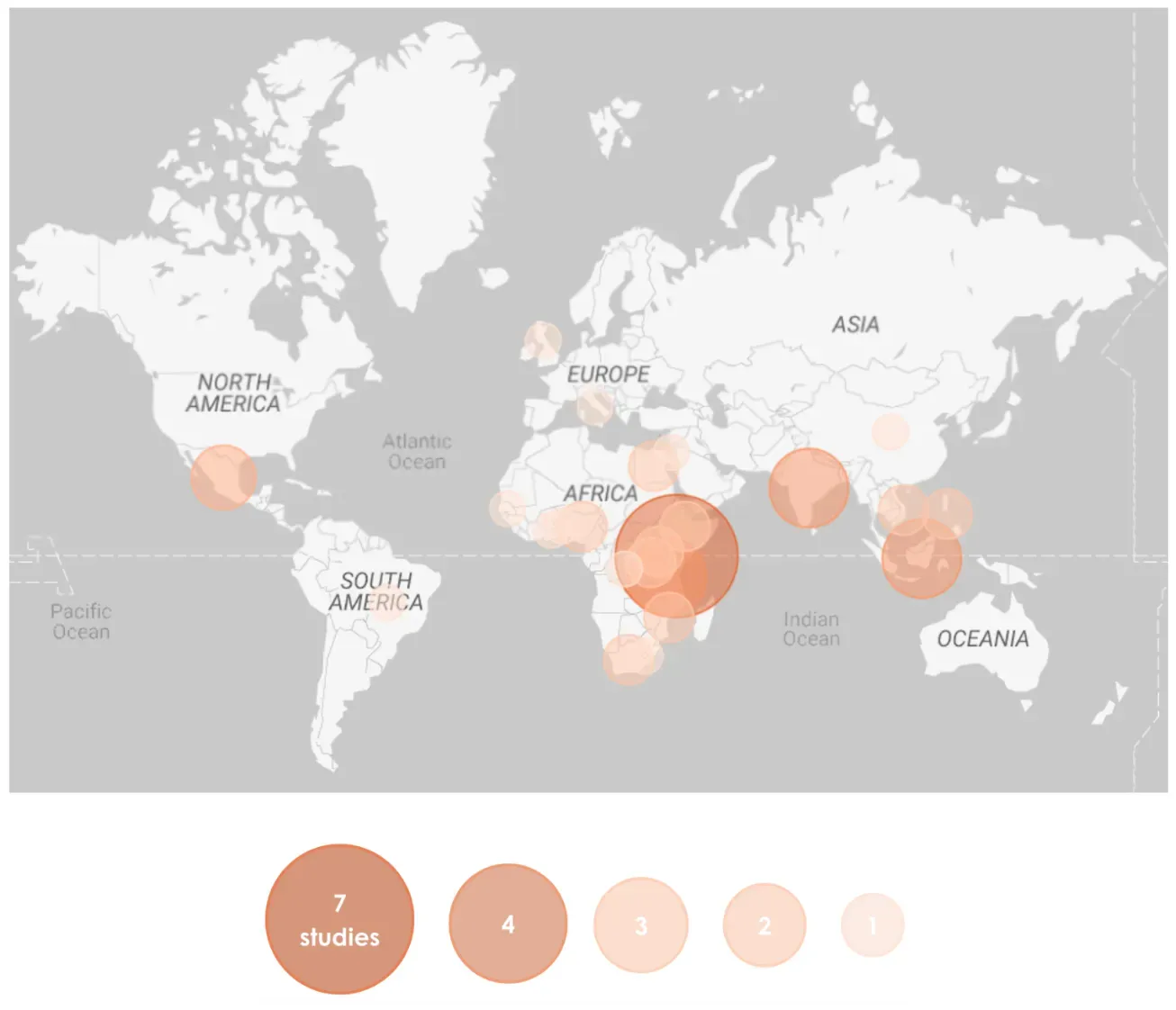
Number of new impact studies identified and added to the Evidence Map, per country.
These updates expand Caribou Digital’s data-driven approach to understanding effective small business digital support. The Evidence Map now has data from more than 140 studies mapped across four digital support categories, 25 interventions, product, or service types, and seven outcome categories. It is the foundation of Caribou Digital’s evidence synthesis process, which compiles and analyzes findings to provide comprehensive insights on what works — and what doesn’t — in supporting small businesses digitally. This approach, which we’ve refined over a decade of work with foundations, government agencies, and private sector organizations, offers an informed foundation for strategic decision-making. You can learn about how we are using evidence, best practices, and analysis within Mastercard Strive in our Insights Library.