From Rangpur to Dinajpur: How Porshi is Transforming the Lives of Rural Women, One Entrepreneur at a Time
Mastercard Strive ―
This post is by ShopUp, a B2B-commerce company that connects mills, brands, and manufacturers to small neighborhood shops.
This post is by ShopUp, a B2B-commerce company that connects mills, brands, and manufacturers to small neighborhood shops, creating a seamless distribution for food and essentials. ShopUp, a Mastercard Strive partner, is implementing Porshi, a program that supports women entrepreneurs in Bangladesh by transforming them into last-mile distribution agents.
In the quiet corners of Bangladesh, a ripple effect is underway: women entrepreneurs in peri-urban and rural areas are taking a leap of faith to improve their financial resiliences and create lasting impact in their communities. How? Through Porshi, a ShopUp initiative co-funded by Mastercard Strive and the Gates Foundation and implemented by Innovision. Porshi is a mobile micro-retail platform designed to help rural women build sustainable businesses from their homes by equipping them with digital tools, training, credit, and ongoing support.
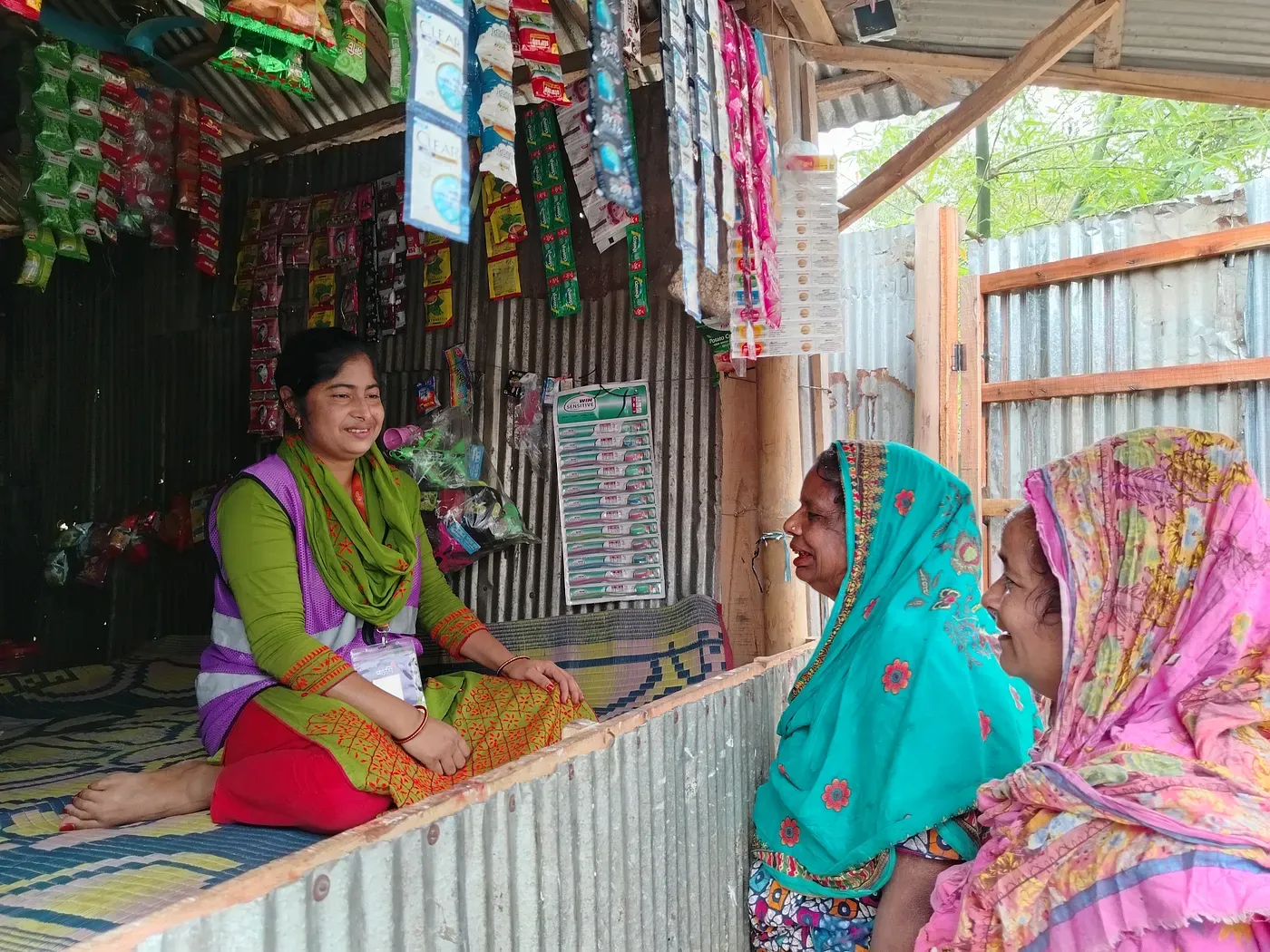
Women entrepreneurs, like Shahina, who grew up in rural Bangladesh, are using the platform to sell household products to their community. Initially, Shahina attended the Porshi training, learning the fundamentals of business, marketing, safe workplaces, and how to use the Porshi app to grow her ventures from home. She then ordered products twice on the Porshi app and sold them at a profit. Seeing the opportunity, one month later, she did the unimaginable: she turned a corner of her house into a small shop.
After starting her journey with Porshi, Shahina’s daily sales now range between BDT 1,500 to 2,000 (USD 12 to 16). She reinvests her earnings right back into her business. Her daily profit, which used to be just BDT 100, has now doubled to BDT 200 — a 100% increase. Over a month, that means her profit jumped from BDT 3,000 to 6,000 (USD 25 to 50).
Early insights on Porshi’s impact
Shahina’s story is one of many “Porshis” across Bangladesh since the initiative began six months ago. Recently, we had the opportunity to assess Porshi’s midline performance. We surveyed a sample of Porshi users to identify early trends and outcomes in women’s engagement, business growth, and financial resilience.
- Income is growing: Women who had a business prior to joining Porshi have seen a 20% growth in their median monthly income (from BDT 2,500 to BDT 3,000). Women with no prior business experience are earning a median monthly income of BDT 500 — a new income stream for those who previously had none. Beyond the averages, there are inspiring cases like Shahina, who, with dedication and consistent effort, has been able to generate profits of BDT 5,000–6,000 per month, demonstrating the greater potential of the model when fully leveraged.
- Business growth is most valued by women: 72% of active Porshi users who have placed multiple orders reported that the Porshi app helped with business growth, including increased order value and income growth. Additionally, 62% reported “building confidence,” “learning new skills,” and “saving time” as additional ways Porshi has helped them.
- Porshis report greater household decision-making power: More than half (56%) of active Porshi users reported that their control over how their household income is spent has increased since joining the project.
Lessons learned so far
In addition to this promising early impact, we’ve learned some important lessons about the women entrepreneurs and the project, especially from women who have only used Porshi once or who are non-adopters. These are helping to shape Porshi going forward.
- Women with certain demographic characteristics are progressing more consistently: We’ve found that women between 26 and 45 with at least secondary education are more likely to achieve income growth, improved financial resilience, and enhanced decision-making power in their households. Conversely, first-time entrepreneurs with limited education or prior business experience face steeper learning curves. For these first-time entrepreneurs, sustained success often depends on the balance between tech and touch-based human support and guidance they receive from field officers, a finding consistent with Mastercard Strive’s global learnings on long-term behavior change. We’re exploring targeted interventions, such as pairing new Porshis with experienced peers, providing extra digital literacy training, or simplifying training content, to ensure success is not limited only to those with pre-existing advantages.
- Establishing trust in the solution is critical: Many Porshis were hesitant to use digital payments for their very first order, as they were unfamiliar with the system and preferred the perceived security of handling cash. To overcome this barrier, we introduced a cash-on-delivery option for first orders as a deliberate step to build trust. This gave Porshis the reassurance of handling cash at the start, while experiencing the platform and delivery process firsthand. Once trust was established, all subsequent transactions shifted to digital payments, keeping us aligned with the long-term goal of a fully cashless model.
- One-time users need enhanced reliability and assistance: For women who placed only one order before dropping off, the most significant barrier was discomfort with paying using a digital platform, as well as other operational and logistical issues. These included late delivery, damaged products, and inadequate support to resolve these issues. To address these concerns, we allocated a dedicated resource for issue resolution, and a specialized support function is now in place to ensure that Porshis receive timely assistance.
- Addressing cultural and social barriers remains critical: Non-adopters reported sociocultural barriers, such as family opposition. Around 6% of Porshis have dropped off due to household pressures, even when family members were originally engaged. We see shifting perceptions as a gradual process that requires continuous support and visible success stories. Even when family support is secured at the start, sustained confidence-building is necessary, and we must continue to work on it. Success stories have a strong influence, but they need time to grow and circulate; this impact can be seen in the long run.
Looking ahead
Today, Shahina is not just surviving — she’s planning. She wants to expand her shop, offer more products, and build a sustainable business to secure her family’s future. Porshi didn’t just give her tools, it gave her confidence and agency in her household.
Empowering one woman touches the lives of many. Her income feeds her children. Her confidence can inspire her neighbors. Her growth shifts the narrative of what rural women can achieve.
Porshi is that ripple effect — starting with one woman, and spreading across villages, towns, and soon, the entire country. And we’re just getting started.