Behind the headlines: The critical role of credit unions in deploying $27 billion in federal…
Mastercard Strive ―
Inclusiv will serve as a critical backdrop as it moves forward with its recent $1.87 billion Greenhouse Gas Reduction Fund Clean Communities Investment Accelerator grant.
After Hurricane Maria ravaged Puerto Rico in 2017, leaving $139 billion worth of damage in its wake, the island’s surviving residents were left without communication, power, banking systems or assistance from the mainland. Many bank branches didn’t re-open for months following the storm, but, within just two days, mission-focused financial cooperatives, or “Cooperativas,” which operate similarly to member-driven credit unions, were open and creating workarounds to keep cash-strapped locals afloat.
Today, there are 94 state-chartered financial cooperatives and five federal credit unions on the island. Puerto Rico’s financial cooperative system has nearly $12 billion in community owned assets and over 1.1 million member-owners (about one-third of the island’s population).
Those numbers can be at least partially attributed to post-Maria investments made by Inclusiv, a New York-based Community Development Financial Institution (CDFI) intermediary and Mastercard Strive USA grantee. Inclusiv set out post-Maria to equip Cooperativas with the financial tools to assist low-income Puerto Ricans, while bolstering Puerto Rico’s financial system and its climate resiliency initiatives. Ninety-eight percent of the financial cooperatives and credit unions in Puerto Rico are members of Inclusiv today.
Armed with decades of experience in the continental U.S., where it had assisted some 20 million residents in low-income, rural, urban and reservation-based communities by providing capital, technical assistance, webinar programs, and vital networking connections for its 500-member credit unions, Inclusiv aimed to get Cooperativas certified as Community Development Financial Institutions (CDFIs) through the U.S. Treasury Department. This would unlock access to funding opportunities and government grants, like the CDFI Fund. At the time, many of these Cooperativas were effectively operating as CDFIs, but lacked the process and certification required to do so officially.
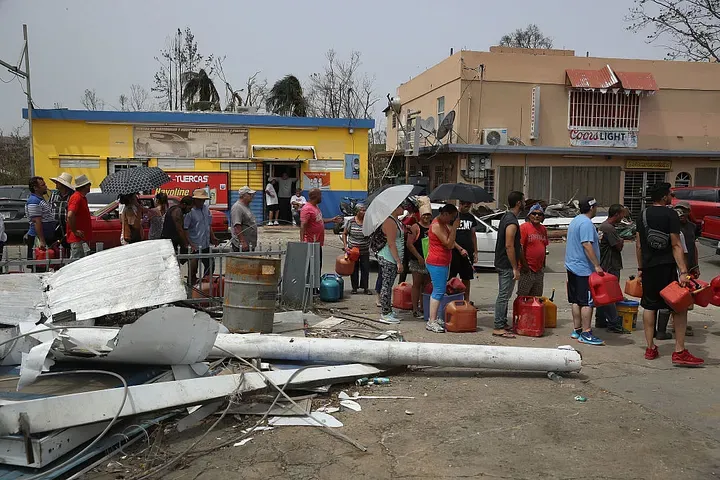
Puerto Rico experienced widespread damage, including to most of the electrical grid, after Hurricane Maria, a category 4 hurricane, passed through in 2017. (Photo by Joe Raedle/Getty Images)
Since Hurricane Maria, Inclusiv has helped the Cooperativas access more than $308 million in CDFI grants, allowing many to create or expand community development lending, including clean energy lending programs to help residents purchase solar power kits, or retrofit homes and businesses. Prior to Inclusiv’s intervention, no Cooperativa had received CDFI funding.
Building a Trusting Foundation
This growth stems from both trust — Coopertivas came to the aid of Puerto Ricans when almost no one else did — and Inclusiv’s wealth of experience, but it wasn’t easy.
It took Inclusiv’s Director of the Puerto Rico Network, Rene Vargas Martinez, and this team five years of trust-building, including visits with Coopertivas to talk to their CEOs and boards, meetings with community leaders and the Department of Treasury to talk about the CDFI Fund, before the needle finally started moving.
“This concept of having a fund to give you money to do what you need to do sounded really weird,” Martinez said on the Next City podcast earlier this year. At first, there was skepticism, Martinez added, due to some traditional barriers, such as language, and a general distrust of federal agencies, that made Cooperativas nervous to partner with an outside organization. But the educational component Martinez brought to the table eventually gave way to success.
“The numbers are coming in now — the growth in the portfolio has been dramatic in the past five years. Because again, all they needed was the capital to be able to lend more. It’s an example of how the nonprofit, the government sector, and community organizations can work together to promote access to capital and to help communities that really need it,” Martinez said.
The Greenhouse Gas Reduction Fund in Action
Inclusiv’s experience building trust in Puerto Rico, as well as its 50-year history working with Community Development Credit Unions (CDCUs) throughout the continental U.S., will likely serve as a critical backdrop as it moves forward with its recent $1.87 billion Greenhouse Gas Reduction Fund Clean Communities Investment Accelerator grant.
This opportunity will put Inclusiv firmly on the forefront of advancing racial and economic equity in U.S. climate finance by creating tools to help community lenders finance clean-energy solutions in low-income communities, which are often overlooked in the climate conversation.
The $27 billion Greenhouse Gas Reduction Fund (GGRF), which is part of the Inflation Reduction Act (IRA), marks a historic influx of federal funding for small businesses and communities to participate in and benefit from the nation’s transition to a clean-energy economy. The funding was dispersed via three grant opportunities: the National Clean Investment Fund, Solar For All, and the Clean Communities Investment Accelerator, which together aim to combat climate change by mobilizing financing for greenhouse gas- and air pollution-reducing projects in communities across the country, with a significant portion set aside for low-income and disadvantaged communities.
The grant awards, announced by the Environmental Protection Agency in April 2024, put nonprofits like Inclusiv on the frontlines of the GGRF due to their expertise in mobilizing financing and private capital to transform markets, and ultimately, the grant dollars will be funneled through small, local businesses, such as installers of solar and other energy efficient equipment as they execute thousands of clean-energy projects at the ground level.
In total, 68 organizations received funding through the GGRF’s three grant programs, ranging in size and scope. Appalachian Community Capital, another CDFI in the Strive USA network, received $500 million through the GGRF to launch the Green Bank for Rural America, a future hub for investment and technical assistance to community lenders, local leaders and workforce development partners across the U.S. Its grant will be leveraged to finance $2.25 billion in 2,750 clean-energy projects, creating 18,000 jobs in rural communities.
The Climate United Fund, a coalition headed by Strive USA advisory board member Beth Bafford, will use the $6.97 billion grant it received from the Clean Communities Investment Accelerator to invest in distributed power generation and storage, building decarbonization and electric transportation through consumers, multi-family housing, community infrastructure, small businesses and farms, schools and minority-serving institutions, and stand-alone generation and power.
A Critical Link to the Local Level
For Inclusiv’s part, over the next six years, it will pass along 90 percent of its $1.87 billion GGRF grant to hundreds of community development credit unions (CDCUs) — at up to $11 million per lender grant — to create new or expand existing green loan programs, or provide financial assistance for clean energy projects to low-income and disadvantaged communities, through a variety of loan products.
Of that, $180 million will be set aside for technical assistance grants to help CDCUs build their capacity to provide financial assistance to Clean Communities Investment Accelerator-approved projects, which must meet established U.S. climate goals and be located in low-income and disadvantaged communities. Technical assistance includes training, market analysis, technical support, hiring staff, developing new financial products and supporting predevelopment activities such as energy audits, feasibility studies and design, engineering, and permit support.
Through the grant, Inclusiv will scale its Solar & Green Lending training program to help build local and national markets for clean energy lending. These 5- to 9-week online sessions for community-based lending institutions cover the knowledge and skills needed to engage in solar and green lending, including market assessment, product development, working with solar installers and developers, underwriting and deal structuring, and program and asset management.
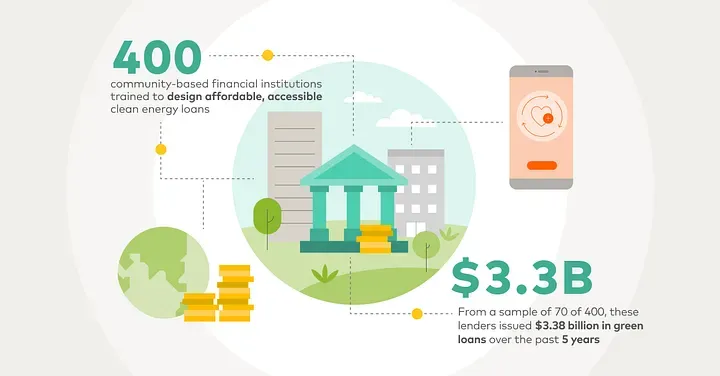
Reporting from just a sample of 70, these lenders have made $3.38 billion in green loans in the past five years.
Since 2019, Inclusiv’s Center for Resiliency and Clean Energy, in partnership with the Carsey School of Public Policy at the University of New Hampshire, has trained close to 400 community-based financial institutions in how to design affordable and accessible clean energy loan products. The results have been impressive. Reporting from just a sample of 70, these lenders have made $3.38 billion in green loans in the past five years.
Ultimately, Inclusiv’s focus is to equip CDCUs with the tools to bring the financial health benefits of clean energy to low-income and disadvantaged communities while supporting local small businesses to provide clean energy services.
Reaching Community Through Credit Unions
Credit unions are uniquely positioned to mobilize at this moment given their deep community roots, particularly in low-income and disadvantaged areas, where trust can be difficult to earn.
Credit unions differ from traditional lending institutions in that they’re member-owned and often community-minded, with a history of investing in communities that traditional lenders view as too risky. They often offer a broader range of products at a cheaper cost, and focus on development and technical assistance services such as financial education, credit counseling, development assistance to address qualification challenges, and help borrowers use their credit and capital effectively, and ultimately improve their financial health.
Their membership base is also quickly growing — before the pandemic, in 2019, credit unions in the U.S. served 121.7 million members, according to statistics kept by the Credit Union National Association; by 2023, it had grown to 140.6 million, as credit unions were quickly able to access and deploy pandemic-era funding. With the GGRF and other government funding on the horizon, demand is expected to continue growing. In the federal reserve’s 2023 CDFI study, credit unions reported an increase in services of 71 percent in the 12 months prior.
But, they face challenges in meeting that demand, such as adequate staffing, technology, operational funding and lending capital, expertise to answer borrower questions around clean energy products in non-technical, clear language, and importantly, building trust in a diverse set of communities.
The Road Ahead is Paved in Trust
While there will certainly be tactical challenges involved in implementing the GGRF, Inclusiv and other organizations charged with deploying the funds know the key to success is trust, a sentiment repeatedly shared by leaders at the Mastercard Strive USA Summit in April.
Solid relationships with community credit unions, like those Inclusiv has formed over decades, will be paramount in ensuring unprecedented federal dollars earmarked for energy efficiency, electrification, solar access and reducing carbon emissions flow to the right local businesses with the expertise — and trust — to support their communities in a time of economic transition.
And Inclusiv won’t be alone as it looks to leverage its grant dollars to touch as many low income and disadvantaged communities as possible. Inclusiv is on the board of the Justice Climate Fund, which was selected for $1 billion to equip its network of some 1,000 U.S. CDFIs with new tools, skills and relationships to advance affordable, green lending in communities across the country, particularly those that are low income and disadvantaged.
With proven programs already in place, and Inclusiv’s deep well of knowledge of other opportunities available, now it’s time to ramp up quickly in response to crisis, just like it did seven years ago in Puerto Rico, this time armed with the rare resources to truly strengthen the nation’s small-business ecosystem while steering a transformation whose impacts stand to reshape the nation’s economic future.
Related articles

Supporting innovations shaping the next chapter in community finance
For small businesses, access to capital often determines what’s possible and what’s not — from expanding a storefront, to upgrading online ordering systems, or making payroll through a slow season.

The network effect: Inside the CDFI networks and associations powering U.S. small business growth
CDFI networks, such as an industry associations or coalitions, function as conveners that capture and reflect the collective voice of members and help their members in many different ways.
Digging deeper roots in a time of change: Looking back on our work supporting small businesses
The key question that emerged from our work in 2025 was: How do we help small business support organizations not only weather these shifts, but turn them into opportunity?

Entrepreneurship and philanthropy in times of change: How more flexible capital can help fix the small business financing gap
Philanthropic funding has always played an important role in the small business sector. As the rate of change accelerates, philanthropic funders are well-positioned to help small businesses adapt.
Bridging opportunities, coordinating action: How Alabama is investing in its small business…
How Alabama leaders are coordinating partnerships, data, and technology to strengthen the small business ecosystem and expand access to resources statewide.

Collaboration as infrastructure: Lessons on strengthening partnerships in the U.S. small business support system
CDFIs share the same mission but their approaches often differ. Increasingly, however, they are finding ways to collaborate. How can we make these collaborations more sustainable and inclusive?
Scaling impact by standardizing data: A conversation on how better analytics and collaboration can unlock more investment for community lending
Having more consistent definitions and standards about community lending data is one of the six shifts identified in our survey of small business support leaders.
High tech, high touch: How community lenders use digital tools to stay personal with small businesses
By Araba Sapara-Grant Maria worked in the flower district in Manhattan for many years, but her dream of opening her own mobile flower shop seemed untenable.
Built for all, built to last: Six shifts that could change the U.S. small business landscape for generations of entrepreneurs
Six key shifts—from flexible capital to stronger partnerships—could transform the U.S. small business ecosystem and improve long-term entrepreneur success.

Funding creativity, fueling small business growth: Bridging the capital gap in the creative economy
The creative economy is one of the worlds fastest growing sectors, representing $2 trillion in economic activity globally and potentially comprising 10% of GDP by 2030.

Improving small business outcomes through mental health: A profile on Our Village United’s holistic model
How Our Village United’s ELEVATE program combines wellness, funding, and mentorship to help underserved entrepreneurs grow resilient, scalable small businesses.

Embracing an abundance mindset in Kansas: How new collaborations are creating a stronger small business ecosystem
The fifth Mastercard Strive USA Summit recently took place in Lawrence, Kansas in partnership with the Kansas Department of Commerce.
From theory to practice to scale: Mastercard Strive USA’s impact on small businesses in year 2
Mastercard Strive USA significantly grew its portfolio, impact, and voice in Year 2 and set the stage for strengthening small business ecosystems further in Year 3.
Challenging assumptions: How a distinct operations model sets CDFIs apart in a vast financial ecosystem
Discover how Community Development Financial Institutions (CDFIs) provide mission-driven financing, expand access to capital, and help underserved entrepreneurs grow sustainable businesses in the U.S.

Why helping small businesses succeed should be a philanthropic priority
To create an equitable economy, grantmakers should address the financial and training hurdles that cause so many entrepreneurs to fail.
Getting impact capital off the sidelines: how CNote aligns investor interests with community financial institutions — and vice versa
A two-year Mastercard Strive USA grant has paved the way for investment platform CNote to strengthen their organizational capacity.
The unique partnership at the center of California’s new loan match program
A unique and first-time partnership between two mission-driven organizations, Next Street and Community Reinvestment Fund USA.
How local government can help more small businesses succeed: A fireside chat between St. Louis Mayor Tishaura O. Jones and Salah Goss of Mastercard
This conversation on the role of local government in helping small businesses succeed took place at the Mastercard Strive USA Summit in St. Louis, Missouri, between Tishaura O.
Inclusive growth for entrepreneurs in North Carolina — and beyond
This article highlights key themes and moments from the fourth Mastercard Strive USA Summit held in Raleigh, North Carolina.
Opening doors and connecting dots: How the small business ecosystem in Missouri is meeting entrepreneurs where they are
This article highlights key themes and moments from the third Mastercard Strive USA Summit held in St. Louis, Missouri.
Meeting small businesses where they are: Technical assistance models that work in an increasingly complex landscape
The technical support entrepreneurs need to launch and grow their businesses can vary widely.
How trust scales impact: The role of local partners in federal programs for small businesses
This article highlights key themes and moments from the second Strive USA Summit in Washington, DC, on April 17, 2024.
Public-private partnerships and small businesses: A conversation on what is working in New York City
This conversation took place at the Mastercard Strive USA Summit in New York City between Kevin D.
Building bridges for small businesses: Highlights from the inaugural Strive USA Summit in New York
Participants at the first Mastercard Strive USA Summit spoke about how to access and leverage the once-in-a-generation investments being made by the federal government.