High tech, high touch: How community lenders use digital tools to stay personal with small businesses
Mastercard Strive ―
By Araba Sapara-Grant Maria worked in the flower district in Manhattan for many years, but her dream of opening her own mobile flower shop seemed untenable.
When investing in digital solutions, how do community lenders whose business models center on trusted, direct connections with small businesses preserve their human touch points?
By Araba Sapara-Grant
Maria worked in the flower district in Manhattan for many years, but her dream of opening her own mobile flower shop seemed untenable. That changed in 2011, when a friend and fellow entrepreneur introduced her to Grameen America, a mission-driven Community Development Financial Institution (CDFI) dedicated to helping underserved women build businesses to enable financial mobility.
Despite having no credit history, Maria was able to secure a $1,000 loan through Grameen America’s low-barrier microloan and group-lending program to open her first retail location in New York. She invested in the right mix of merchandise and inventory and realized success quickly. Since then, she’s grown her business steadily with Grameen America by her side every step of the way — receiving 27 loans totaling $200,000 in capital invested in her flower business over the past 14 years.
“With Grameen America I feel more supported. I worry less because I know I have help when I need it. It’s a huge economic help,” Maria said.
Grameen America supports entrepreneurs like Maria through a high-touch, high-tech model — an approach they have spent years developing and refining with the goal of supporting the women entrepreneurs most in need.
Importantly, they have not tried to implement multiple digital technology projects all at the same time. Instead, they have taken a phased approach with their digital transformation. For example, pre-pandemic, they identified, implemented, and rolled out a new loan management platform. During the pandemic, Grameen America shifted to digital payments and prepaid cards in partnership with Mastercard in order to better serve their customers. And Grameen America’s most recent technological piece came in the form of its new mobile application, MyGrameen, which helps members manage their loans, apply for new capital, and access account information, while freeing up Grameen America loan officers to invest more time in deepening relationships with their members.

New tech, new opportunities
In a recent national survey of more than 30 senior leaders from the mission-driven lenders and business support organizations that make up the Mastercard Strive USA portfolio, respondents, including Grameen America, emphasized this approach of balancing digital innovation with a personal touch for community leaders to best support their clients, and stressed the need for more resources to identify and implement such technological investments. This insight and consensus on the need to “boost technology investment” — and others from the survey — helped inform Mastercard Strive USA’s broader strategy to strengthen the small business ecosystem by focusing on six key shifts, including capital, technology, data, and trust.
“For small businesses, particularly the ones we work with, the biggest challenge is having access to the right kind of capital, resources, and support network. This is why we emphasize both technology and personal connection — what we call ‘high tech, high touch.’ While we want everyone to feel comfortable using self-service options, smaller businesses sometimes need more guidance,” one leader wrote in the survey.
For Grameen America, the new layer of technology has been successful for both the organization and its members. Since its launch, 98% of members are registered, and 85% of loan applications are completed through the app. Further, relationship managers have reduced their time spent on operational responsibilities, saving member-facing staff an average of three or more hours per week. That’s time they can invest into cultivating deeper relationships with members and recruiting new entrepreneurs to tap into their services.
“Trust is key to the success of Grameen America’s model, and it will always be at the foundation of everything we do,” said Marcus Berkowitz, Chief Product and Innovation Officer at Grameen America, who has led the organization’s technology transformation and data strategy. “Our interactions with each member are highly personalized, which builds trust with the growing network of women we serve across America.”
The digital ROI
Other community lenders around the country are also tapping into technology to strike a similar balance, as the need for digital transformation that crystallized during the pandemic continues to be a top priority across the U.S. small business ecosystem. But does investing in technology automatically equate to a sacrifice of personal connection with members?
Grameen America has seen the opposite, with the MyGrameen app allowing managers to spend time on client relationships by pushing administrative tasks toward the app. This experience is backed up by the survey results. While a shift toward better leveraging technology to automate and scale some of their services could be seen as backing away from the tailored one-on-one support that makes community lenders stand out among their larger counterparts, survey responses indicate that finding the right balance between high-tech solutions and high-touch support actually has the opposite effect.
“There has to be that empathy and connection to a human being,” one CEO responded, when speaking to the need to expand support for technical assistance. “We’re providing tools to leverage that human infrastructure, but to provide it in a more efficient and effective way, to make it an overall better experience.”
Accessity, a 30-year-old Southern California CDFI that aims to open up financial opportunity to low- and moderate-income entrepreneurs, has seen this play out in real time through a focused technology investment in AI. When leadership realized that 80 percent of the client calls staff members were fielding were only related to 20 percent of their core process or services, Accessity decided to invest in an AI-powered chatbot to help clients quickly get the information they need, while freeing up critical time for their staff to build more meaningful relationships, like supporting clients with financial, business, and credit training through educational webinars, or assisting with credit and budgeting and other financial wellness programs. Mastercard Strive USA supported this work after Accessity applied to, and won, an award through its inaugural Innovation Fund, which focused on finding and supporting early-stage digital- and data-centric solutions with the potential to drive outsized impact for small businesses across the United States. The end result? The implementation of the chatbot resulted in a 50 percent decrease in the number of calls received from its clients — time saved that staff redirected to focus on getting to know their clients better so they can offer more tailored support.
“At Accessity, we believe that empowering entrepreneurs requires the right balance between innovation and human connection,” says Mar Diteos, the CEO of Accessity. “By leveraging AI-powered tools like our chatbot, we streamline operations and give our team more time to do what they do best — deliver personalized support and expert guidance to small business owners. This thoughtful integration of technology and hands-on guidance elevates the client experience and contributes to our impressive 94% business survival rate two to three years after receiving a loan.”
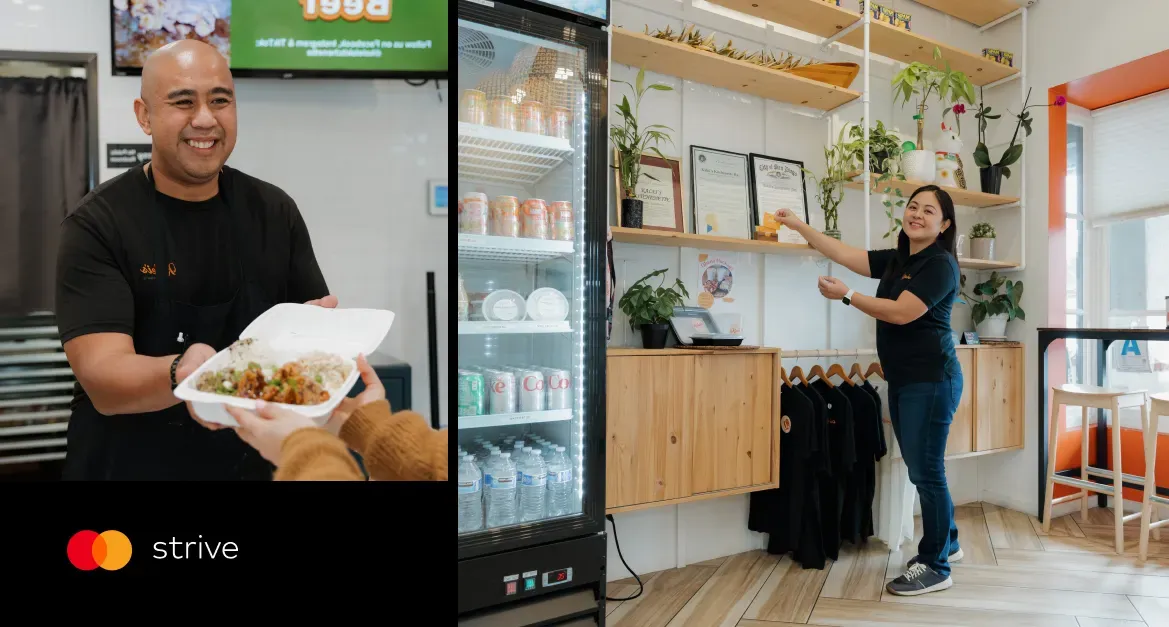
Accessity’s AI tools help small business owners like Chef Andy and Khara Mangiduyos of Kalei’s Kitchenette in San Diego, California, get approval for their loan application.
Access to technologies like a mobile app or chatbot — which do not necessarily require a total digital transformation of the organization — can make a real difference. A forthcoming study on community financial institutions leveraging Mastercard Strive USA-funded digital products and services found that 67 percent of surveyed organizations reported an improvement in organizational efficiency, and 75 percent reported improved capabilities in supporting small businesses.
But making these digital investments and realizing their benefits doesn’t come without challenges. Many organizations surveyed reported that they had never before used technology to address their capacity challenges. They often lack the awareness of available technology that could improve their efficiencies, and struggle to identify and evaluate suitable technology alternatives that would be the right fit for their operations. On top of that, they often face resource constraints that create a major barrier to implementation and access, both in terms of technology implementation costs as well as hiring and retaining the talent necessary to support it.
“Organizations recognize technology’s transformative potential but struggle with limited staff capacity and technical expertise, particularly CDFIs and nonprofit lenders who compete with larger institutions for technical talent,” according to the survey results.
One way forward could come in the form of shared technological infrastructure and industry-wide platforms that can be leveraged across multiple organizations, instead of each organization investing resources into building individual solutions.
Even once an organization identifies the right solution, there will inevitably be hiccups implementing new technology and adapting existing processes to account for the new technology. And once implemented, additional support may be needed as the model shifts to build capacity and reach new clients. There’s also the challenge of change management among staff when new technology changes long-standing policies and procedures — management needs to get buy-in and train staff on new systems.
For Grameen America, the rollout of MyGrameen was intentionally slow and carefully managed, with significant time spent testing and coordinating with third-party vendors. While the process was resource-intensive, Berkowitz and other leaders knew from past experience that launching a glitch-free app was critical — any early missteps could undermine member trust and hinder long-term adoption.
A ticking clock for support
For organizations like Grameen America and Accessity, regardless of whether the technology investments are part of a larger transformation or a more focused initiative, overcoming the challenges to implementation has more than paid off in efficiencies realized, and will directly lead to more small business owners succeeding in their ventures. And that’s the ultimate goal. With the record number of new businesses formed during the pandemic nearing the close of the critical five-year window when nearly half of small businesses fail, according to the U.S. Bureau of Labor Statistics, the clock is ticking on making sure these new entrepreneurs have the necessary support to succeed.
Through its investments in organizations like Grameen America, Accessity, and dozens of other small business support organizations, Mastercard Strive USA is aiming to support community lenders that are exploring innovative solutions to drive efficiency and impact across the small business ecosystem — but more resources will be needed to help more intermediaries take the technological leap and support them through the process, so they can in turn better support their small-business customers, like Maria.
Through her 14-year relationship with Grameen America, Maria has marked many major milestones with their support, like stocking her shop with fresh flowers from different countries, opening up a brick-and-mortar shop, moving to a larger location, and expanding into online sales and a flower delivery service, all while building a savings cushion and supporting her three children. It’s a business success story that Maria wants more women to be able to tell.
“I wanted to become independent, work for myself, be my own boss, and make my own decisions. I wanted to prove to myself that I could run a business on my own and succeed. I want women like me to know that they can do what I did — be independent and work while supporting and having time for my children.”
This article is part of Mastercard Strive USA’s ‘Six Shifts’ small business support series, which highlights how ecosystem leaders are putting strategy into action to improve small business outcomes — from capital and tech to timing, data, and trust.
Want to learn more or connect directly? Reach out to us at striveusa@mastercard.com.
You can also see a summary of the ‘Six Shifts’ on this fact sheet or learn more about Mastercard Strive USA’s impact in this snapshot about our partners and work.
Related articles

Supporting innovations shaping the next chapter in community finance
For small businesses, access to capital often determines what’s possible and what’s not — from expanding a storefront, to upgrading online ordering systems, or making payroll through a slow season.

The network effect: Inside the CDFI networks and associations powering U.S. small business growth
CDFI networks, such as an industry associations or coalitions, function as conveners that capture and reflect the collective voice of members and help their members in many different ways.
Digging deeper roots in a time of change: Looking back on our work supporting small businesses
The key question that emerged from our work in 2025 was: How do we help small business support organizations not only weather these shifts, but turn them into opportunity?

Entrepreneurship and philanthropy in times of change: How more flexible capital can help fix the small business financing gap
Philanthropic funding has always played an important role in the small business sector. As the rate of change accelerates, philanthropic funders are well-positioned to help small businesses adapt.

Bridging opportunities, coordinating action: How Alabama is investing in its small business…
How Alabama leaders are coordinating partnerships, data, and technology to strengthen the small business ecosystem and expand access to resources statewide.

Collaboration as infrastructure: Lessons on strengthening partnerships in the U.S. small business support system
CDFIs share the same mission but their approaches often differ. Increasingly, however, they are finding ways to collaborate. How can we make these collaborations more sustainable and inclusive?
Scaling impact by standardizing data: A conversation on how better analytics and collaboration can unlock more investment for community lending
Having more consistent definitions and standards about community lending data is one of the six shifts identified in our survey of small business support leaders.
Built for all, built to last: Six shifts that could change the U.S. small business landscape for generations of entrepreneurs
Six key shifts—from flexible capital to stronger partnerships—could transform the U.S. small business ecosystem and improve long-term entrepreneur success.

Funding creativity, fueling small business growth: Bridging the capital gap in the creative economy
The creative economy is one of the worlds fastest growing sectors, representing $2 trillion in economic activity globally and potentially comprising 10% of GDP by 2030.

Improving small business outcomes through mental health: A profile on Our Village United’s holistic model
How Our Village United’s ELEVATE program combines wellness, funding, and mentorship to help underserved entrepreneurs grow resilient, scalable small businesses.

Embracing an abundance mindset in Kansas: How new collaborations are creating a stronger small business ecosystem
The fifth Mastercard Strive USA Summit recently took place in Lawrence, Kansas in partnership with the Kansas Department of Commerce.

From theory to practice to scale: Mastercard Strive USA’s impact on small businesses in year 2
Mastercard Strive USA significantly grew its portfolio, impact, and voice in Year 2 and set the stage for strengthening small business ecosystems further in Year 3.

Challenging assumptions: How a distinct operations model sets CDFIs apart in a vast financial ecosystem
Discover how Community Development Financial Institutions (CDFIs) provide mission-driven financing, expand access to capital, and help underserved entrepreneurs grow sustainable businesses in the U.S.

Why helping small businesses succeed should be a philanthropic priority
To create an equitable economy, grantmakers should address the financial and training hurdles that cause so many entrepreneurs to fail.

Getting impact capital off the sidelines: how CNote aligns investor interests with community financial institutions — and vice versa
A two-year Mastercard Strive USA grant has paved the way for investment platform CNote to strengthen their organizational capacity.

The unique partnership at the center of California’s new loan match program
A unique and first-time partnership between two mission-driven organizations, Next Street and Community Reinvestment Fund USA.
How local government can help more small businesses succeed: A fireside chat between St. Louis Mayor Tishaura O. Jones and Salah Goss of Mastercard
This conversation on the role of local government in helping small businesses succeed took place at the Mastercard Strive USA Summit in St. Louis, Missouri, between Tishaura O.
Inclusive growth for entrepreneurs in North Carolina — and beyond
This article highlights key themes and moments from the fourth Mastercard Strive USA Summit held in Raleigh, North Carolina.

Behind the headlines: The critical role of credit unions in deploying $27 billion in federal…
Inclusiv will serve as a critical backdrop as it moves forward with its recent $1.87 billion Greenhouse Gas Reduction Fund Clean Communities Investment Accelerator grant.
Opening doors and connecting dots: How the small business ecosystem in Missouri is meeting entrepreneurs where they are
This article highlights key themes and moments from the third Mastercard Strive USA Summit held in St. Louis, Missouri.

Meeting small businesses where they are: Technical assistance models that work in an increasingly complex landscape
The technical support entrepreneurs need to launch and grow their businesses can vary widely.

How trust scales impact: The role of local partners in federal programs for small businesses
This article highlights key themes and moments from the second Strive USA Summit in Washington, DC, on April 17, 2024.
Public-private partnerships and small businesses: A conversation on what is working in New York City
This conversation took place at the Mastercard Strive USA Summit in New York City between Kevin D.
Building bridges for small businesses: Highlights from the inaugural Strive USA Summit in New York
Participants at the first Mastercard Strive USA Summit spoke about how to access and leverage the once-in-a-generation investments being made by the federal government.